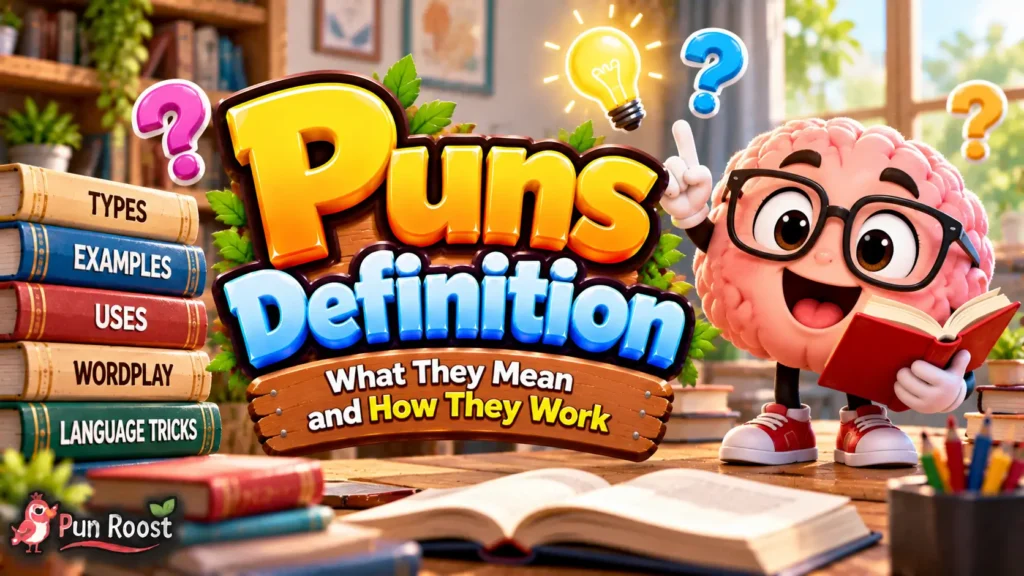
Learn the puns definition, types, examples, uses, and differences between puns, wordplay, jokes, and related language tricks.
The puns definition is simple at its core: a pun is a form of wordplay that deliberately uses multiple meanings, similar sounds, or related spellings to create a humorous, clever, or memorable effect. Cambridge defines a pun as a humorous use of a word or phrase with several meanings or one that sounds like another word.
Puns can be funny, clever, silly, dramatic, or subtle. You may find them in jokes, headlines, advertisements, books, movies, social media captions, business names, and everyday conversation. Their appeal comes from making one expression point toward two meanings at once.
Table of Contents
What Is a Pun? 📝
A pun is a deliberate play on language. It usually depends on a word having multiple meanings, or on two words sounding alike or similar enough to create a second interpretation. The humor comes from the reader noticing that shift.
Consider this simple example:
I used to work at a bakery, but I couldn’t make enough dough.
The word dough has its ordinary food-related meaning in the bakery setting, while dough can also mean money in informal English. The sentence works because both meanings fit the joke. This is the basic engine behind many puns.
A pun does not always have to produce a huge laugh. Sometimes it creates a clever moment of recognition. That is why people often describe puns as witty, groan-worthy, playful, or intentionally corny.
Where Does the Word Pun Come From? 📚
The modern English word pun dates to the mid-17th century. Oxford Advanced Learner’s Dictionary says its origin is uncertain, giving a possible connection to the older word pundigrion and punctilio. The history is less certain than the definition itself, so it is better to describe the origin as a proposed etymology rather than a settled fact.
The formal literary term paronomasia is also commonly used for punning. In modern English, though, “pun” is the everyday term most readers will recognize.
Puns themselves are much older than the modern label. Writers have used ambiguity, sound similarity, and multiple meanings for centuries in literature, rhetoric, advertising, and everyday speech.
Pun Definition in Simple Words 💬
In plain English, a pun is a word joke. The writer chooses a word or phrase that can be understood in two ways, or that sounds like another useful word, and builds the sentence around that overlap.
For example:
I used to be a banker, but I lost interest.
“Interest” can refer to money earned from banking or to curiosity and attention. The sentence uses both meanings at once.
That is the core idea to remember: one piece of language, two interpretations, one deliberate twist.
How Do Puns Work? 🔍
Puns work by creating linguistic ambiguity. The reader first understands a familiar meaning, then notices another possible meaning connected to the same sound, spelling, or word.
That mental switch is what gives a pun its effect. Instead of changing the entire situation, the joke changes how you interpret one important word.
For example:
The bicycle couldn’t stand on its own because it was two-tired.
The wordplay connects two-tired with too tired. The sentence sounds like an ordinary explanation until the second meaning clicks.
This is why short puns can be surprisingly effective. A single sound or word can carry the setup and punchline simultaneously.
Puns are also useful because they can do more than create humor. Writers may use them to highlight irony, reinforce an idea, create a memorable phrase, or reveal something about a character.
Common Types of Puns 🧩
There is no single classification system that every source uses in exactly the same way. Still, several categories appear repeatedly in explanations of punning. The useful question is: what linguistic relationship creates the second meaning? citeturn563735search0turn563735search2
Homophonic Puns 🔊
Homophonic puns use words that sound the same or nearly the same but have different meanings and often different spellings.
I used to work at a flour shop, but I kept getting mixed up.
The humor depends on the close sound relationship between flour and flower or another context that makes the second sound available. Homophonic puns often work especially well when heard aloud.
Homographic Puns ✍️
Homographic puns use words that share the same spelling but have different meanings. Pronunciation may stay the same or change.
The fisherman sat on the bank while checking his balance.
Here, bank can mean a financial institution or the edge of a river.
Homonymic Puns 🎯
Homonymic puns rely on words that share spelling and sound while carrying different meanings.
The carpenter knew the job would be a great success because he had all the right tools on hand.
The humor can come from a word that fits both a literal situation and a broader expression, especially when the sentence lets both interpretations surface.
Polysemous Puns 🔄
A polysemous pun uses one word that has several related meanings.
The photographer developed a strong relationship with his work.
The word developed can refer to processing photographs while also referring to growth or progress.
Compound Puns 🧩
Compound puns stack more than one wordplay mechanism into the same line.
The baker needed more dough, so he rolled with the idea and rose to the occasion.
Several bakery-related meanings work together instead of relying on a single twist.
Recursive Puns ♻️
A recursive pun becomes clearer after another pun or reference is understood. The second layer depends on the first.
These are often more complex than simple one-word puns because the reader has to recognize one connection before the next one makes sense.
Visual Puns 👀
Visual puns combine language with an image, design, object, or layout.
For example, a café sign showing a large cup beside the words “Thanks a latte” combines the literal drink with a familiar phrase. Visual puns are common in advertising, packaging, posters, memes, and social media graphics.
The categories can overlap. A single pun may be homophonic and compound, or visual and polysemous at the same time.
What Are Some Easy Pun Examples? 😄
The fastest way to understand the concept is to see several different examples side by side. Each one creates humor by making one word do more than one job.
The exact mechanism changes from example to example, but the principle stays the same: a word, sound, or phrase supports two interpretations.
Puns vs Wordplay 🤔
A common question is whether pun and wordplay mean the same thing. They overlap, but they are not always identical.
Wordplay is the broader category. It includes creative manipulation of language for humor, style, meaning, or effect. Puns are one specific type of wordplay. Cambridge lists “play on words” as a synonym for pun while also distinguishing wordplay as a broader related concept.
A simple way to think about it is:
Wordplay: the broad family.
Pun: a particular form of wordplay that creates an effect through multiple meanings, similar sounds, or related linguistic ambiguity.
For example, inventing a clever phrase may be wordplay without being a clear pun. A sentence that deliberately exploits the double meaning of bat, bank, or light is much more clearly pun-based.
Puns vs Jokes 😂
Puns and jokes often overlap, but they are built differently.
A traditional joke may depend on a setup followed by a punchline. The humor can come from an unexpected event, character behavior, exaggeration, or a sudden change in context.
A pun can be much smaller. Sometimes a single word is enough to carry the entire joke.
Compare these:
Traditional joke:
Why did the tomato turn red? Because it saw the salad dressing.
Pun:
I tried to catch some fog, but I mist.
The first relies mainly on a humorous situation. The second depends on the sound relationship between mist and missed.
This does not mean every pun is a complete joke by itself. A pun can appear inside a longer joke, story, advertisement, title, or piece of dialogue.
Why Do People Use Puns? 💡
Puns are useful because they communicate a surprising amount of information in very little space. A well-made pun can be funny while also making the reader think about language.
Writers use them for several reasons.
To create humor: This is the most obvious use. Puns can turn an ordinary sentence into a playful one.
To grab attention: Puns are memorable, which makes them useful for headlines, advertising, signs, and titles.
To add personality: A character who constantly makes puns may come across as playful, clever, awkward, or deliberately silly.
To create irony: A carefully chosen double meaning can highlight a contradiction or create an additional layer of interpretation.
To make language memorable: A compact word twist can stay in a reader’s mind longer than a plain statement.
That is why puns appear in both casual humor and more serious writing. They are not limited to dad jokes or comedy lists.
Why Are Puns Sometimes Called “Bad” Jokes? 🙃
Puns have a special relationship with groans. People sometimes call them “bad jokes” even when the wordplay is clever.
That reaction is part of the culture around pun humor. A pun may be intentionally obvious, corny, or predictable. The joke can become funnier because everyone recognizes how forced the wordplay is.
For example:
I am reading a book about anti-gravity. It’s impossible to put down.
Even when the audience sees the twist coming, the satisfaction comes from recognizing how the second meaning fits the sentence.
A pun does not always need to be sophisticated. Sometimes the best pun is simply clear, fast, and shamelessly cheesy.
Puns vs Double Entendre 🤔
A pun and a double entendre can overlap, but they are not interchangeable in every context.
A pun is a broad form of wordplay based on multiple meanings or similar sounds. A double entendre usually refers to an expression with two interpretations, often with one that is suggestive or risqué. That means a double entendre can be a kind of pun, but not every pun is a double entendre. citeturn563735search0
For general family-friendly humor, “pun” is usually the more useful term.
Puns vs Spoonerisms and Malapropisms 🔤
Puns are deliberate wordplay that exploits ambiguity, sound, or meaning. Related language tricks work differently.
A spoonerism swaps sounds between words, such as accidentally reversing the opening sounds in a phrase. A malapropism uses an incorrect but similar-sounding word. These can be funny, but the mechanism is different from a deliberate pun.
Knowing the distinction helps when explaining why a particular joke is a pun rather than another type of language mistake or wordplay.
What Does “No Pun Intended” Mean? 😄
“No pun intended” is a common phrase used after wording that contains a possible pun. Sometimes it is sincere, but it is also often used playfully to acknowledge an obvious or cheesy word twist. citeturn221116search1turn221116search3
For example:
The new bakery really rose to the occasion. No pun intended.
The phrase can call attention to the wordplay without changing the underlying joke. In short-form writing, however, the pun often works better when it is allowed to stand on its own.
Where Are Puns Used? 📚
Puns appear in far more places than joke collections.
Literature
Authors use puns to create humor, ambiguity, irony, characterization, and additional meaning. Literary discussions of puns often point to their ability to make readers interpret a word in more than one way.
Headlines
News and magazine headlines often use puns because a clever title can attract attention and make the subject easier to remember.
Advertising
Brands use puns to create catchy slogans, product names, campaign titles, and promotional messages.
Social Media
Instagram captions, memes, short posts, videos, and comments are naturally suited to compact wordplay.
Movies and Television
Characters may use puns as part of their personality, while titles and promotional material can also rely on double meanings.
Everyday Conversation
People make puns casually all the time. Sometimes they plan them, and sometimes a double meaning appears accidentally.
Puns in Literature, Advertising, and Pop Culture 🎬
Puns are not limited to joke lists or dad humor. Writers use them in literature, headlines, advertising, titles, scripts, and everyday media because one short phrase can carry more than one idea. Scribbr and other educational references note that puns commonly appear in literature, film, comedy, and everyday language. citeturn563735search0turn563735search6
In literature, a pun can add irony or reveal a character’s attitude. In advertising, a pun can make a slogan easier to notice and remember. In social media, a compact pun can communicate the topic and the joke at the same time.
That flexibility is one reason punning remains useful even outside obviously comedic writing.
What Makes a Good Pun? 🏆
A technically correct pun is not automatically a good one. Strong puns usually combine clear wordplay with a satisfying second meaning.
A useful pun often has five qualities.
The wording is understandable. The audience should be able to recognize the connection without a long explanation.
The two meanings fit. Both interpretations should feel relevant to the sentence.
The twist is noticeable. The alternative meaning should create a small moment of surprise.
The phrasing feels natural. If the sentence sounds too forced, the joke can lose its effect.
The humor serves a purpose. A pun is stronger when it improves the sentence instead of appearing only because the writer wants to insert wordplay.
The best puns usually make the reader think, “Oh, I see it,” rather than, “You had to explain that?”
How to Make Your Own Puns ✏️
Creating a pun becomes easier when you start with words that have multiple meanings or useful sound-alikes.
Begin with a topic such as food, animals, work, sports, travel, or school. Then make a list of related words.
For example, suppose your topic is cooking.
You might collect words such as stir, season, grate, bake, roll, knead, dough, and whisk.
Next, look for alternate meanings:
Then build a sentence where both meanings make sense.
For example:
I knead a vacation after all this baking.
The sentence connects knead with need while staying connected to the cooking topic.
The trick is not to force every possible word into a joke. One strong connection is usually better than several weak ones.
A Simple Formula for Writing Better Puns 🛠️
A practical pun-writing process looks like this:
For example:
I knead a vacation after all this baking.
The joke connects knead and need while staying firmly inside the cooking topic.
The best puns usually depend on one strong connection rather than several weak ones.
What Is the Difference Between a Pun and a Double Meaning? 🔄
A double meaning is the foundation for many puns, but not every sentence with two meanings is automatically a pun.
A phrase can be ambiguous simply because language allows several interpretations. A pun deliberately uses that ambiguity for an effect, usually humor, cleverness, irony, or emphasis.
For instance, the word light can mean not heavy or something that produces illumination. That is simply a fact about the word.
But if someone says:
I brought a light suitcase because I wanted to travel light.
The sentence deliberately exploits two meanings of light. That turns the ambiguity into wordplay.
So the important element is intention and context.
Are Puns Only Meant to Be Funny? 🎭
No. Humor is one of the most common uses, but puns can also create irony, emphasize an idea, add literary depth, or encourage readers to notice multiple meanings.
A writer might use a pun because one word perfectly expresses two related ideas. In literature, that can allow a short phrase to carry more meaning than a straightforward statement.
That is one reason puns can appear in serious creative writing as well as obvious comedy.
Pun Examples by Mechanism 🧠
Seeing the mechanism can make the definition easier to remember.
Double meaning:
The math teacher has too many problems.
“Problems” can mean questions to solve or difficulties in life.
Homophone:
I used to work in a bakery, but I couldn’t make enough dough.
“Dough” can refer to bread mixture or money.
Homographic meaning:
The fisherman checked the bank balance.
“Bank” can refer to a financial institution or the edge of a river.
Visual pun:
A coffee image paired with “Thanks a latte” creates a second layer through the picture and phrase together.
The shared principle is always the same: the language gives the reader more than one plausible interpretation, and the writer deliberately uses that overlap.
FAQ’s About Puns Definition ❓
The simple puns definition is a form of wordplay that uses multiple meanings, similar sounds, or related linguistic features to create a humorous or clever effect.
A pun is a word joke that uses two meanings, similar sounds, or related word forms to create a clever or humorous effect.
A common alternative is play on words. The term paronomasia is also used in literary and linguistic discussions of punning.
Common categories include homophonic puns, homographic puns, and puns based on multiple meanings. Visual puns are another practical category used in advertising, memes, and other visual media.
Not exactly. Wordplay is the broader category, while a pun is a particular kind of wordplay based on multiple meanings, similar sounds, or related linguistic ambiguity.
Puns often create humor by making the reader recognize an unexpected second meaning. The shift between the expected interpretation and the alternative one creates the punch.
Yes. Puns can be used for irony, emphasis, characterization, literary depth, and other effects beyond simple comedy.
Yes. Puns are commonly discussed as a literary or rhetorical device because writers can use them to create multiple meanings, humor, irony, and stylistic effects.
Start with a word that has two meanings or a useful sound-alike. Then write one sentence where both interpretations fit naturally. The cleaner the connection, the stronger the pun tends to be.
Conclusion
Understanding the puns definition starts with one simple idea: language can carry more than one meaning at the same time. Puns take advantage of that flexibility by turning multiple meanings, similar sounds, visual associations, and clever ambiguity into humor or another memorable effect.
Once you recognize the mechanism, puns become easier to spot and easier to create. Look for words with double meanings, listen for sound-alikes, and build sentences where both interpretations belong. A good pun does not need a complicated setup. Sometimes one well-chosen word is enough to make the whole sentence click.
For a concise dictionary definition and additional usage examples, see the Cambridge Dictionary entry for pun.
This roundup is part of our Pun Craft & Best-Of Guides collection.
Keep the streak going with Clown Puns.
You will probably enjoy more wedding puns as well.
When you are ready for more, head over to Teacher Puns.
If this one made you smile, take a look at more peach puns too.